Insights / For employers
Small Business Health Costs Are Climbing Again: What Montana Employers Can Do in 2026
Small-group rates are set to rise about 11% in 2026. What that means for Montana small businesses, and how membership-based care can help.
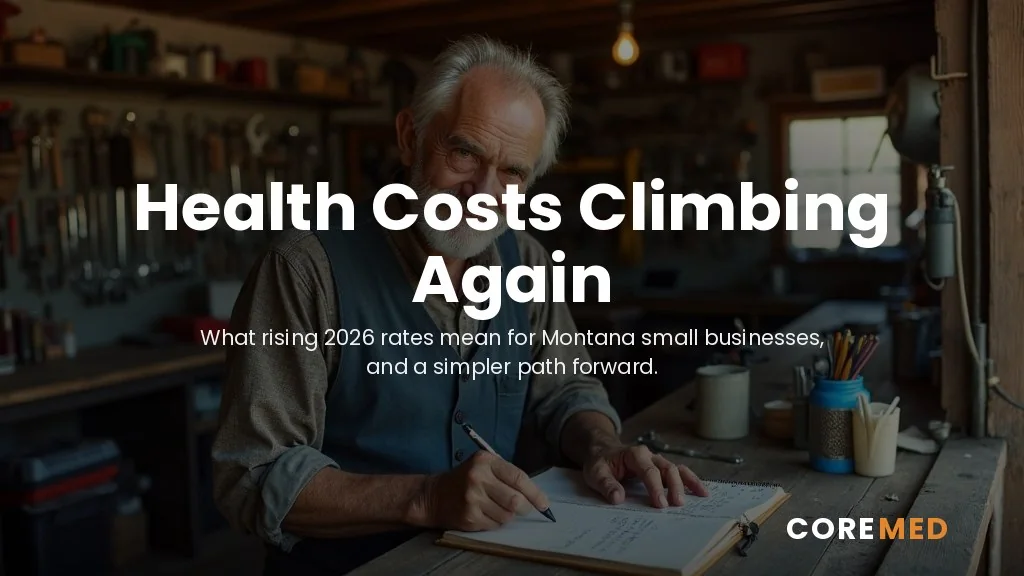
If you run a small business, you know the moment. The renewal letter shows up, you open it at your desk, and the number is bigger than last year's number. Again.
New research says that moment is about to sting a little more. Analysts at the Peterson-KFF Health System Tracker reviewed rate filings from 318 small-group insurers across all 50 states and found a median proposed premium increase of about 11 percent for 2026. Most insurers are asking for increases between 5 and 15 percent. Roughly one in ten is asking for 20 percent or more. Only three insurers in the entire country requested a decrease.
Why the numbers keep going up
The KFF team dug into the filings to see what insurers are pointing at, and the reasons will sound familiar. The underlying cost of care keeps rising: insurers commonly estimate that hospital care, physician services, and prescriptions will cost about 9 percent more next year. Expensive specialty medications, including the popular GLP-1 drugs, are showing up in more budgets. General inflation and labor shortages are pushing up what providers charge. And the small-group insurance market itself is shrinking, which means the costs get spread across fewer businesses.
That last part matters. When healthier groups leave for other options, the businesses that remain tend to pay more, which nudges more of them to leave too. It is a cycle that has been building for years, and small employers are the ones caught in the middle of it.
What this looks like on Main Street
For a shop in Kalispell, a contractor in Helena, or a family restaurant in Billings, an 11 percent jump is not an abstract statistic. It is real money that has to come from somewhere: thinner margins, higher employee contributions, or a scaled-back offering. Some owners quietly stop offering anything at all, and then worry about losing good people because of it.
Here is the thing, though. The renewal letter is not the only lever you have. A growing number of Montana businesses are rethinking how they handle the everyday side of healthcare, which is where most of the visits actually happen.
A simpler way to handle everyday care
Direct primary care, or DPC, is a straightforward idea. Instead of billing an insurance company for every visit, a clinic charges a flat monthly membership. In return, members get a real relationship with their care team: appointments that are easy to get, visits that do not feel rushed, and answers by phone or text when something comes up. No surprise bill for a sore throat. No wondering what a checkup will cost this time.
To be clear, a membership like this is not insurance and does not replace it. It handles the everyday layer of care, and many families and businesses pair it with other arrangements for the big, unexpected events. What it does change is the experience and the predictability of the care people use most often.
That is the model CoreMed was built on. One membership covers your primary care, and it works the same whether your team is in Eureka, the Flathead Valley, Helena, Missoula, Bozeman, or Billings. For employers, the whole package is often 40 to 60 percent less than traditional group insurance, and your employees get care they will actually use instead of a card they are afraid to swipe.
Questions worth asking before your next renewal
You do not have to overhaul anything overnight. But before you sign next year's paperwork, it is worth asking a few questions. How much of what we pay for is care our team actually uses? Are people skipping doctor visits because of the out-of-pocket cost? What would it mean for morale and hiring if going to the doctor were simple and predictable? And is there a way to structure this that fits our budget instead of fighting it?
For a lot of Montana small businesses, the honest answers point toward a simpler setup: predictable monthly costs for everyday care, arranged around the way your people actually live and work.
The bottom line
The 2026 rate filings tell a clear story. The cost of doing nothing is going up about 11 percent, and the pressures behind that number are not going away. You cannot control what insurers file with regulators. You can control how your business approaches everyday care, and that choice is bigger than most owners realize.
If you are curious what a membership would look like for your team or your family, the easiest first step is our quote calculator. It takes a couple of minutes and there is no pressure attached. You can also reach us anytime at info@coremedhealth.com.
This article is general information, not medical or financial advice. Source: Peterson-KFF Health System Tracker, "How much and why premiums are going up for small businesses in 2026," September 2025.