Insights / For families
Finding a Doctor Accepting New Patients in Montana
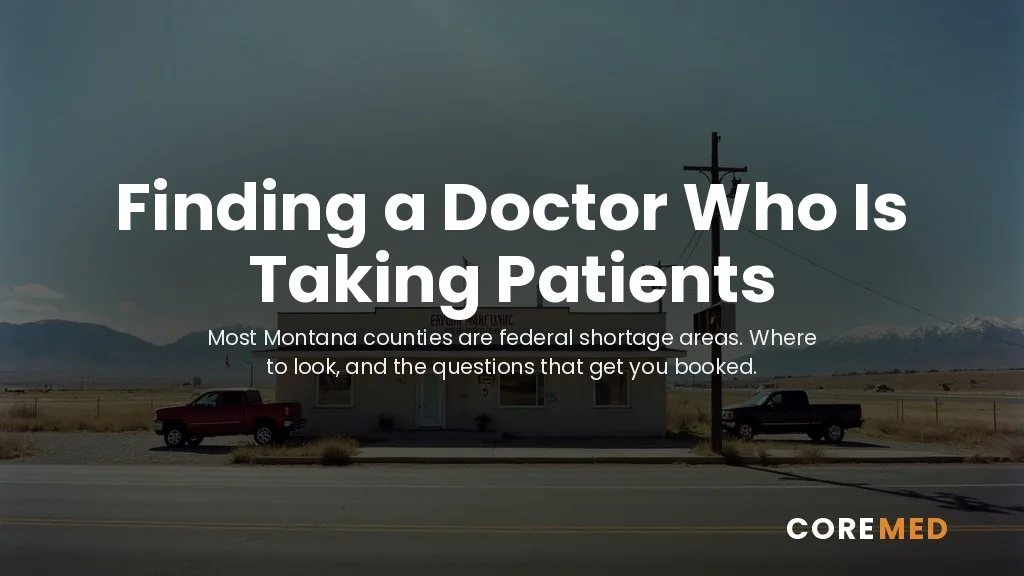
Most Montana counties are federal primary care shortage areas. Which practices are most likely to say yes, and the six questions that get you booked.
"Accepting new patients" is one of the most searched phrases in Montana healthcare, and one of the hardest to get a straight answer on. Here is why it is difficult here specifically, and a practical way through it.
Why it is hard in Montana
The scarcity is real and it is measurable.
Nearly half of Montanans, about 499,000 of 1.1 million, live outside metro areas. That is one of the highest rural shares in the country. Serving that geography is a network of 50 critical access hospitals, 62 rural health clinics and 57 federally qualified health center sites.
Most Montana counties are federally designated primary care shortage areas, meaning there are not enough primary care providers for the people who live there. So when you cannot get an appointment for eleven weeks, that is not you being unlucky. That is the structural situation.
Start with the practices most likely to say yes
Federally qualified health centers. FQHCs are required to see patients regardless of ability to pay and charge on a sliding scale based on income. They are frequently accepting when private practices are not. There are 57 sites across Montana.
Rural health clinics. Sixty-two of them, often attached to a critical access hospital, and often with shorter waits than the regional centre an hour away.
Direct primary care practices. These deliberately keep small patient panels, which means they can usually take you quickly. That is the entire design of the model. The trade-off is a monthly fee.
Nurse practitioners and physician assistants. In Montana, NPs practise independently. Restricting your search to physicians only can double your wait for no clinical reason.
A search that actually works
- Search by clinic, not by "doctor near me". Individual providers move. Clinics have websites and phone numbers that stay put.
- Phone rather than use the web form. Front desks know today's answer. Websites are often months stale.
- Ask three specific questions: Are you accepting new patients, what is the wait for a first appointment, and is there a waiting list I can join?
- Ask about cancellations. Many practices will call you for a same-week slot if you say yes to short notice.
- Widen the radius before you widen the timeline. A forty-minute drive next week usually beats a local appointment in March.
- Ask what a self-pay visit costs if you are uninsured. The answer is often far lower than people expect and it removes a barrier that stops a lot of people calling at all.
What to have ready when you call
- Your date of birth and address
- Current medications and doses
- Any conditions being managed
- Where your records are now, so they can be requested
- How you intend to pay, whether that is a plan, a membership or cash
Having this to hand is often the difference between being booked on the call and being told someone will ring back.
Why it is worth the effort
There is good evidence that having a doctor who knows you is not just more pleasant, it is measurably better.
A study published in January 2026 in the Journal of the American Board of Family Medicine examined Medicare records from over a million patients across nearly 5,000 primary care practices. Patients with the most consistent ongoing relationship with a physician had roughly 7 to 10% lower total healthcare spending, about 5 to 9% lower odds of being hospitalised the following year, and about 5 to 6% lower odds of an emergency room visit.
An association, not proof, and a Medicare population. But it points the same way as decades of prior work: continuity matters. Which is a reason to keep making calls rather than defaulting to urgent care indefinitely.
In the meantime
While you are waiting on a first appointment, do not let things drift.
Telehealth handles a surprising amount of what people wait months for, particularly medication check-ins and deciding whether something needs an in-person look. Urgent care handles the acute middle. And for anything genuinely serious, an emergency department must screen and stabilise you regardless of ability to pay. The where to go for care guide covers how to pick.
Where to look in your region
CoreMed publishes every clinic in its network by region with an address, a phone number and opening hours, before you sign up for anything. If you just want a list of real practices in your area to start phoning, the find care pages are that list, covering Eureka, the Flathead Valley, Helena, Bozeman and Billings, with Missoula opening next.
Use it as a directory whether or not a membership is ever right for you. If you want help working out who is likely to be accepting in your area, email info@coremedhealth.com.
Rural facility counts and shortage-area designations are from the Rural Health Information Hub Montana state guide, reviewed April 2026. This article is general information, not medical advice.