

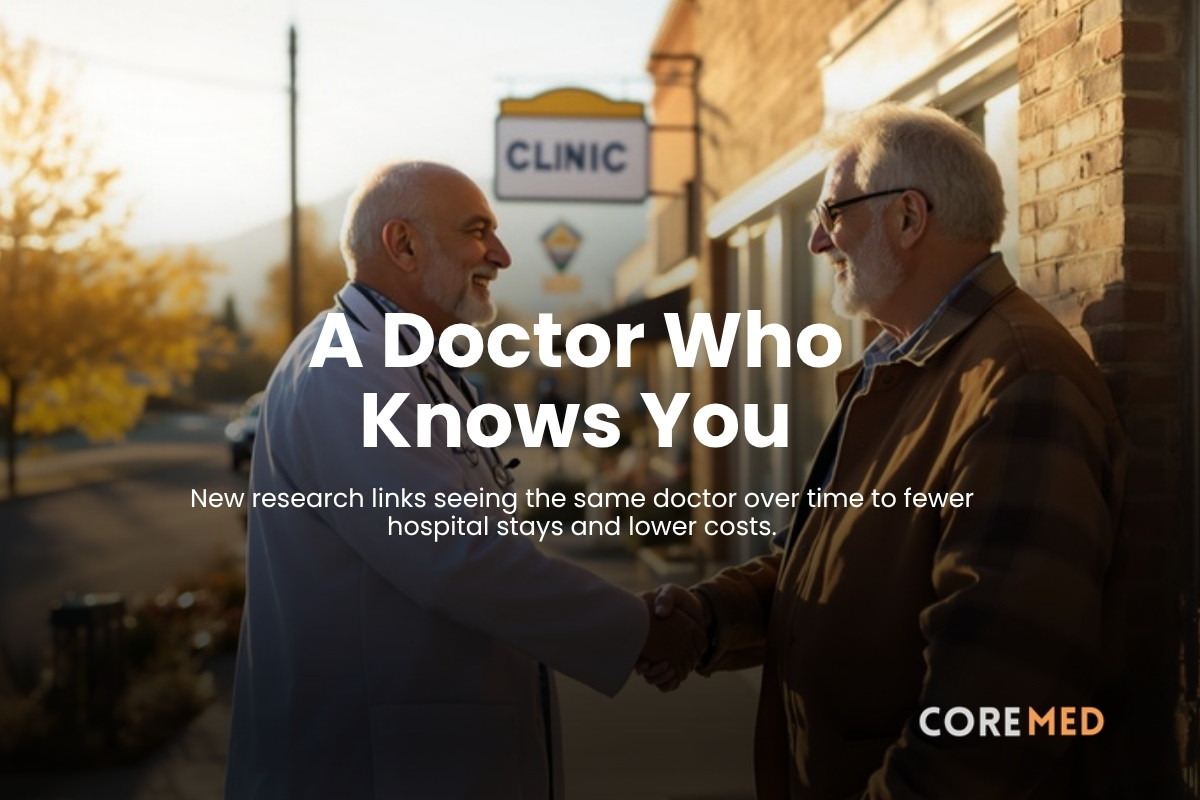
A Doctor Who Knows You: The Quiet Advantage of Seeing the Same Physician
There is something quietly powerful about walking into a clinic where the person in the white coat already knows your story. Not the version squeezed into a 12-minute appointment, but the whole thing: the knee that acts up every hunting season, the blood pressure you have been working on, the fact that you care for an aging parent and sometimes put off your own checkups.
For a long time, that kind of relationship felt like a nice-to-have. New research suggests it may be one of the most practical things you can do for your health, and for your wallet.
What the research found
A study published in January 2026 in The Journal of the American Board of Family Medicine looked at what happens when patients consistently see the same primary care physician. Researchers analyzed Medicare records from more than a million patients across nearly 5,000 primary care practices nationwide.
The pattern was clear. Patients whose doctors had the most consistent, ongoing relationships with their patients had roughly 7 to 10 percent lower total healthcare spending than those with the least consistent care. They also had about 5 to 9 percent lower odds of being hospitalized in the following year, and about 5 to 6 percent lower odds of an emergency room visit.
A few honest caveats. This study looked at Medicare patients, so the findings may not translate exactly to every age group. And it shows a strong association, not proof of cause and effect. Still, it lines up with years of research pointing the same direction: continuity of care, the simple act of seeing a doctor who knows you, keeps showing up alongside better outcomes and lower costs.
Why a familiar doctor makes a difference
None of this is magic. It is what happens when medicine gets to work the way it was meant to.
A doctor who knows you can spot change. When your physician has seen you at your baseline, they notice when something is off, sometimes before you do. Small problems get caught while they are still small.
A doctor who knows you repeats less. Fewer duplicate tests, fewer "let's start from the beginning" conversations, fewer referrals that could have been handled in the exam room.
And a doctor who knows you earns your trust. You are more likely to bring up the thing you were embarrassed to mention, follow through on advice from someone you know, and call the clinic instead of waiting until a small worry becomes an urgent one.
Why it is getting harder to find
Here is the frustrating part: the typical healthcare system makes this kind of relationship difficult. Many primary care doctors carry patient panels of 2,000 or more, which means short visits, packed schedules, and a good chance of seeing whoever happens to be available rather than the doctor who knows your history.
That is a big part of why direct primary care has been growing so quickly across the country. Industry data from Hint Health's 2026 Direct Primary Care Trends Report shows the model has expanded dramatically since 2017, in large part because it is built around exactly what the research keeps highlighting: smaller patient panels, longer visits, and easy ways to reach your own doctor between appointments by text, email, or phone.
What this looks like in Montana
At CoreMed, this is the heart of how we designed our membership. Direct primary care means your provider is not rushing through a waiting room of thousands. You see the same care team, they know your history, and you can reach them when something comes up instead of defaulting to urgent care for questions a quick message could answer.
We serve communities across Montana, from Eureka and the Flathead Valley to Helena, Missoula, Bozeman, and Billings. In towns like ours, being known by your doctor is not a luxury item. It is how small-town healthcare always worked at its best, and it is worth protecting.
One important note: a CoreMed membership is not insurance. It is a different way to get consistent, relationship-based care, built around direct primary care.
The takeaway
If you have a doctor you trust and who knows you, hold on to that relationship. It is doing more for you than it may seem. If you do not have one, or your visits feel like starting over every time, it may be worth looking at care models built around continuity rather than volume.
This article is general information, not medical or financial advice. Please talk with a qualified professional about your own situation.
Curious what relationship-based care could look like for you or your family? Visit coremedhealth.com or reach out anytime at [email protected]. We are happy to talk it through, no pressure.


